
Periodontal Maintenance in Chattanooga, TN
After gum disease treatment, your cleanings change. Here’s what periodontal maintenance actually is, why it’s on a shorter interval, and how we approach it at Wilcox Family Dental.

What Periodontal Maintenance Actually Is
Periodontal Maintenance in Chattanooga TN is the cleaning protocol that follows treatment for gum disease. It is not the same as a routine cleaning, and it is not a marketing label we put on top of one. Once the supporting bone and tissue around your teeth have been affected by periodontitis, the way we clean below the gumline changes, and so does the interval between visits. Most patients on this protocol come in every three to four months instead of every six.
The reasoning is simple. Bacteria below the gumline repopulate the pockets around your teeth on a predictable timeline, usually around twelve weeks. If we wait six months, those pockets have had time to deepen and inflame the tissue again, and the progress you made during scaling and root planing or gum surgery starts to erode. The shorter interval keeps the bacteria count low enough that your body can hold the line.
Dr. Rollings will tell you plainly whether you actually need to be on this schedule, whether you can step back to a standard cleaning after a period of stability, or whether something in between makes sense. We’re not interested in keeping you on a more expensive interval than the evidence supports.
How Periodontal Maintenance Differs from a Standard Cleaning
A standard prophylaxis cleans the crowns of your teeth and just slightly below the gumline. It assumes healthy attachment between the gum and the tooth, with pocket depths of roughly one to three millimeters. Periodontal maintenance assumes the opposite: that you have pocket depths deeper than that, prior bone loss visible on X-ray, or a history of active disease that has been brought under control.
Practically, that means we spend more time below the gumline with hand instruments and ultrasonic scalers, working into the pockets we measured at your last appointment. We’re removing biofilm and calculus from root surfaces that are no longer covered by healthy attachment. We re-measure pocket depths each visit and chart them, because the chart is how we know if something is getting worse before you can feel it.
We also look at the full picture each time: how the tissue is responding, whether there’s any new mobility in a tooth, whether your home care is reaching the places that tend to flare up, and whether any restorations need attention. None of this is busy work. It’s how we catch a problem at three millimeters of recession instead of five.
Who Needs Periodontal Maintenance and How Often
If you’ve completed treatment for periodontitis, whether that was non-surgical therapy like scaling and root planing or a surgical procedure, periodontal maintenance is the standard of care afterward. It is not optional in the sense that returning to a routine six-month cleaning typically allows the disease to progress again. Periodontitis is a chronic condition we manage, not a one-time infection we cure.
Most patients are on a three-month interval for the first year or two after active treatment. If your tissue stabilizes, pocket depths stay shallow, bleeding points are minimal, and your home care is consistent, we may extend to four months. Some patients with controlled disease and excellent hygiene move to alternating maintenance visits with a hygienist who handles routine cleanings, but that’s a decision we make together based on what your charting actually shows.
Other factors push the interval shorter rather than longer: diabetes that isn’t well controlled, smoking, certain medications that affect gum tissue, a family history of aggressive periodontitis, or implants placed in areas with prior bone loss. We’ll tell you which of these apply to you and why they matter, instead of just handing you a recall card.
What's Included in a Periodontal Maintenance Visit
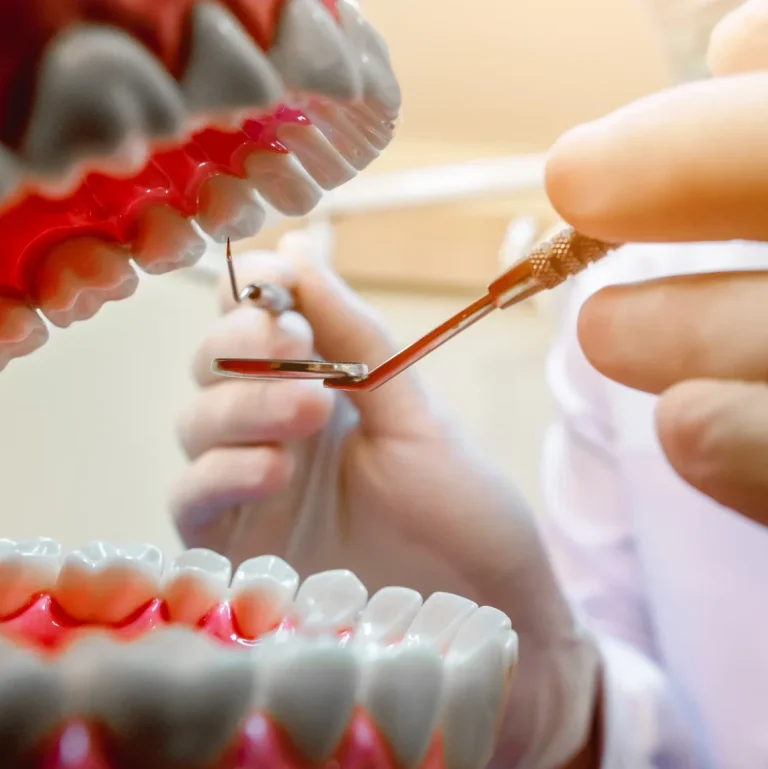
Each visit starts with a review of your medical history and any changes since we saw you last, because medications and systemic conditions affect the gums directly. We update digital X-rays on an evidence-based schedule, not every visit, and we’ll show you the comparison images so you can see what we’re seeing. Dr. Rollings or your hygienist will use an intraoral camera when something is worth a closer look.
Then we measure and chart pocket depths around every tooth, note any bleeding or recession, and check tooth mobility. Cleaning includes subgingival scaling with ultrasonic and hand instruments, root surface debridement where pockets are deeper, polishing, and a fluoride application if your root surfaces are exposed and sensitive. We finish by walking through what we found, what changed since last time, and what to focus on at home over the next three months.
If we find a spot that’s getting worse despite maintenance, we say so directly. Sometimes that means adjusting the interval, sometimes it means a localized re-treatment, and occasionally it means a referral. We’d rather have that conversation early than pretend the chart looks fine when it doesn’t.
Insurance and Payment for Periodontal Maintenance
Periodontal maintenance is billed under a different code than a standard prophylaxis (D4910 versus D1110), and most dental insurance plans cover it, often at the same frequency as routine cleanings or sometimes more often when the diagnosis supports it. We accept Medicaid and all major insurance providers, and we’ll verify your specific benefits before your appointment so you know what’s covered and what isn’t.
If you don’t have insurance, or your plan limits maintenance visits to two per year when you actually need four, we’ll give you a written estimate before we start anything. We offer financing through CareCredit, Cherry, and QuickPay for patients who want to spread the cost out. If cost is part of how you make decisions about your care, say so, and we’ll work through the numbers with you.
Why Staying on Periodontal Maintenance Matters
Periodontitis is the leading cause of tooth loss in adults. Once the bone that holds your teeth in place has receded, it does not grow back on its own. Maintenance is how we keep the bone you have left and avoid the more expensive interventions down the road: extractions, bone grafting, implants, or partial dentures. The math on a three-month cleaning versus replacing a tooth is not close.
There’s also a systemic angle worth being honest about. The inflammation from untreated gum disease is linked to cardiovascular disease, complications in diabetes management, and adverse pregnancy outc.webpomes. We’re not going to claim a cleaning prevents a heart attack. We will tell you that keeping chronic oral inflammation under control is one of the more straightforward things you can do for your overall health.
We serve patients across Chattanooga, East Ridge, Red Bank, Hixson, Soddy-Daisy, and Signal Mountain. If you’ve been treated for gum disease somewhere else and want to continue maintenance with us, bring your records and we’ll pick up where the last office left off, after Dr. Rollings looks at your current charting and decides whether anything needs to be re-evaluated.
Ready to Get on a Maintenance Schedule That Fits
Call Wilcox Family Dental to schedule your periodontal maintenance visit, or to talk through whether this is the right protocol for you. We’ll review your charting with you and explain the reasoning before we recommend an interval.