
Partial Dentures in Chattanooga, TN
If you’re missing a few teeth and weighing your options, a partial denture is often the most practical way to chew comfortably and speak clearly again without committing to surgery. Dr. Rollings will walk you through how it works, what it costs, and what else is on the table before you decide.
What to Know Before Choosing Partial Dentures
A partial denture replaces some of your teeth, not all of them. At Wilcox Family Dental, we fit Partial Dentures in Chattanooga TN for patients who still have healthy natural teeth they want to keep, but who have gaps that are making it hard to chew on one side, harder to smile in photos, or harder to keep neighboring teeth from drifting. The goal is straightforward: fill the gaps in a way that’s stable, comfortable, and something you’ll actually wear.
Dr. Rollings starts every partial denture conversation the same way. We look at your X-rays and intraoral camera images together, identify which teeth are stable enough to anchor a partial, and talk about what’s bothering you most right now. Sometimes a partial is clearly the right call. Sometimes a fixed bridge or an implant makes more sense for the long run. We’ll tell you which option we’d choose for our own family and why, including the option to do nothing yet if the gap isn’t causing functional problems.
We see patients from across Chattanooga, East Ridge, Red Bank, Hixson, Soddy-Daisy, and Signal Mountain for this. Some have lost teeth recently to fracture or extraction. Others have been missing teeth for years and finally have the time and resources to address it. Both situations are normal, and neither requires a lecture.
How a Partial Denture Actually Works in Your Mouth
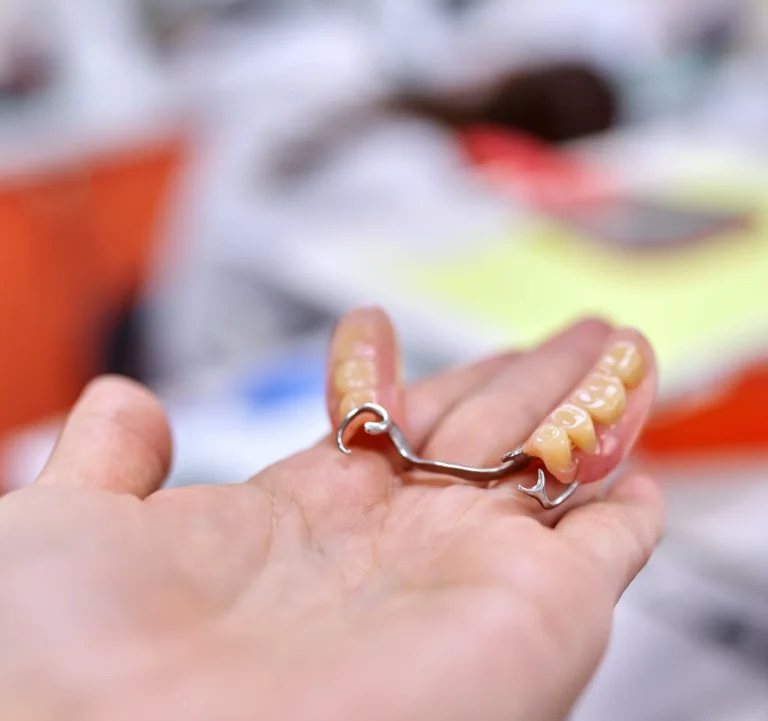
A partial denture is a removable appliance with replacement teeth set into a base that matches your gum tissue. It clasps onto the natural teeth on either side of the gap, which is why those anchor teeth need to be in good shape before we move forward. If they’re not, we address that first. Putting a partial on weak teeth tends to accelerate the problem instead of solving it.
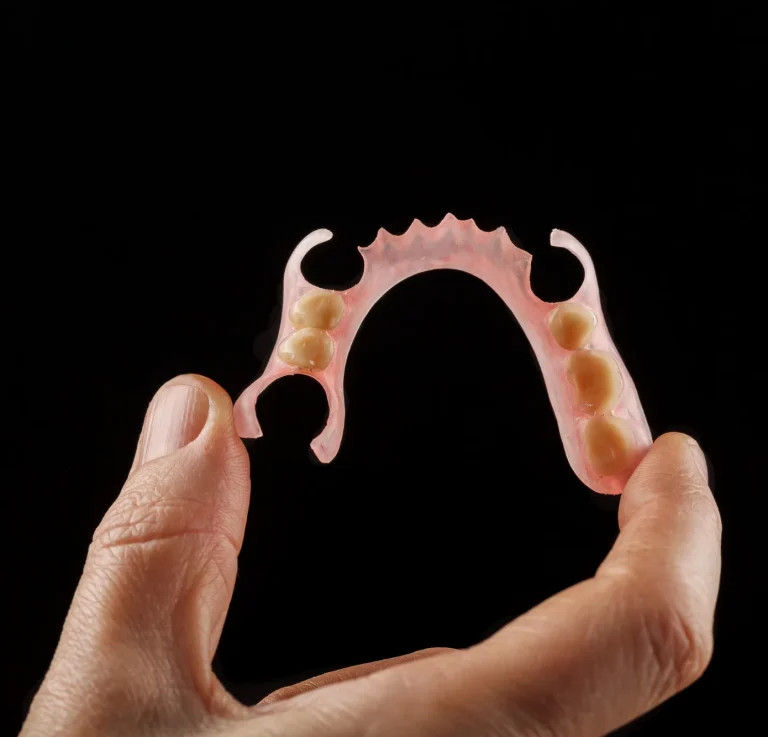
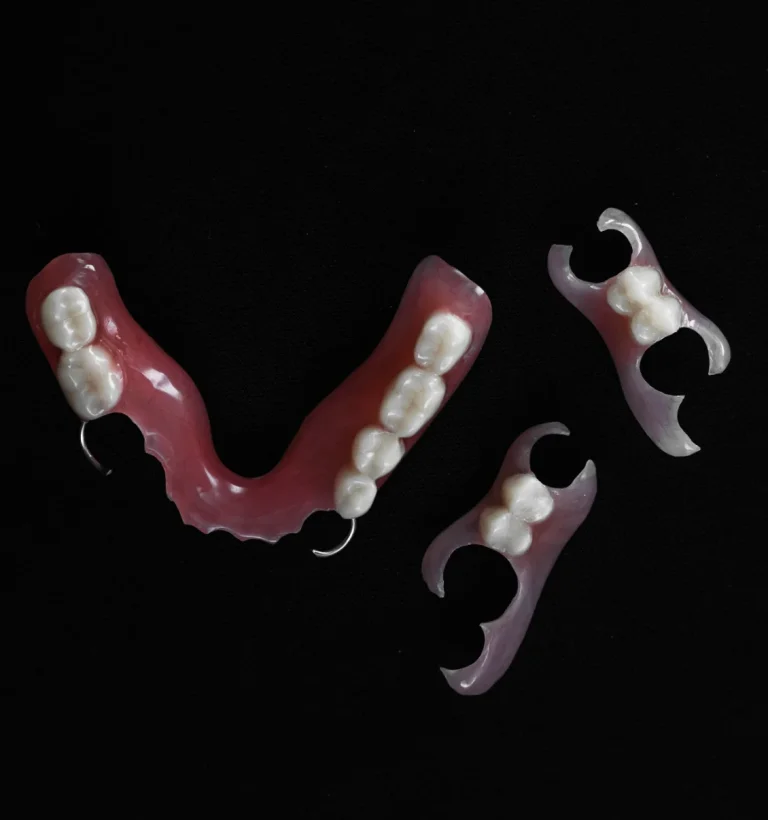
There are a few different ways to build one. A traditional cast-metal partial uses a thin metal framework that’s strong, slim, and lasts the longest. A flexible partial uses a softer thermoplastic base that hides the clasps better and tends to feel less bulky, which some patients prefer for front teeth. An acrylic partial is usually a temporary or transitional option, often used while the gums heal after an extraction or while you’re deciding on a more permanent restoration. Each has trade-offs, and Dr. Rollings will explain which one fits your bite, your budget, and what you’re trying to accomplish.
Whichever style you choose, the process is the same in shape. We take impressions, send them to one of our local partner labs, and have you back for a fitting. Most patients need at least one adjustment after the first week or two, because how a partial sits in your mouth on day one is rarely how it sits a month in. That’s expected, not a problem. We’ll see you back as many times as it takes to get it right.
Who Partial Dentures Make Sense For (and Who Should Consider Something Else)
Partial dentures work well for patients who have several missing teeth in the same arch, healthy remaining teeth to anchor the appliance, and a preference for something non-surgical. They’re also a reasonable choice when implants aren’t financially feasible right now, or when bone loss would require grafting before implants could even be considered. A partial today doesn’t close the door on implants later.
There are situations where we’d point you in a different direction. If you’re only missing one tooth between two healthy neighbors, a fixed bridge or a single implant is usually a better long-term answer than a removable partial. If you’ve lost most of the teeth in an arch, full dentures may be more comfortable and more stable than a partial trying to hang on to too few anchors. And if your remaining teeth have significant decay or periodontal disease, we treat that first. A partial built on a shaky foundation doesn’t last.
If you’re not sure which category you’re in, that’s what the consultation is for. We’ll look at the same X-rays together, point to what we see, and tell you what it means and what your options are. If a partial is the right answer, we’ll say so. If it isn’t, we’ll say that too.
What's Included When You Get a Partial Denture at Wilcox Family Dental
Your first visit is an exam and a conversation. We take digital X-rays and intraoral camera images, evaluate the teeth that would anchor the partial, and check your gums and bite. If any prep work is needed (a cleaning, a filling on an anchor tooth, an extraction of a tooth that can’t be saved), we’ll lay that out in a written estimate before we start. You see the plan and the numbers on paper, not after the fact.
From there, the partial denture itself involves impressions, a lab turnaround through one of our trusted local labs, and a delivery appointment where we seat the partial and check the fit. We coach you on how to put it in and take it out, how to clean it, and what to expect during the first week of wearing it. Sore spots are common early on, and we adjust them at no extra charge. That’s part of the service, not an upsell.
Follow-up is built in. Partial dentures need periodic relines as your gums change shape over the years, and the clasps occasionally need adjustment. We’ll tell you honestly when a reline will get you another few years out of the same partial and when it’s time to remake it. Most well-cared-for partials last five to ten years; some last longer.
Insurance, Medicaid, and Payment Options for Partial Dentures
Partial dentures are usually covered, at least in part, by dental insurance, and they’re often covered under Tennessee Medicaid for eligible adults. We accept Medicaid and all major insurance providers, and we’ll verify your benefits before treatment so you know what your plan covers and what you’d owe out of pocket. If cost is part of how you make decisions about care, say so. We’ll give you a written estimate before we start anything, not after.
If insurance doesn’t cover the full cost, or if you don’t have dental coverage, we work with CareCredit, Cherry, and QuickPay for financing. These let you spread payment over months instead of paying all at once. We’re happy to walk through the options with you at the front desk and help you figure out which one fits your situation. Nobody at Wilcox Family Dental is going to push you toward a more expensive option than you need.
Why Replacing Missing Teeth with a Partial Is Worth Doing
Gaps don’t stay gaps. When you lose a tooth, the teeth on either side gradually tip toward the space, and the tooth opposite it in the other arch can drift upward or downward. Over a few years, that shifting changes your bite, makes cleaning harder, and sets up new problems in teeth that used to be fine. A partial denture holds that arrangement in place and lets you chew on both sides again.
There’s also the practical day-to-day. Patients tell us they stopped ordering steak, stopped laughing with their mouth open in photos, stopped eating in front of coworkers. A partial denture won’t feel exactly like your natural teeth, and we’re honest about that. But it gives you most of the function back and most of the appearance back, and for a lot of patients that trade is well worth making.
If a partial isn’t the right fit later, you haven’t wasted the money. Many of our patients use a partial for years, then move to implants or a different restoration when the timing makes sense. We can help you think through that progression as part of the same conversation, alongside options like crowns and bridges or a full mouth reconstruction if your situation calls for it.
Ready to Talk Through Your Options?
Book a consultation with Dr. Rollings and we’ll look at your X-rays together, explain what we see, and give you a written estimate before any work begins. No pressure, no surprises.